
Web Design
Web Design Glasgow: The Complete 2026 Guide to Choosing a Website Designer, Agency or Freelancer
Freelancers, specialist developers, agencies, template builders and AI platforms can all produce something that looks impressive in a sales demo. This guide is about what happens after launch — and how to judge the difference before you sign anything.
Contents
Choosing someone to build your website has become harder, not easier. A Glasgow business can pick between an independent designer, a specialist developer, a traditional web design agency, a template platform or an AI site builder — and every one of them can put a good-looking homepage in front of you within a week.
The real differences only surface later: when the site is being crawled and indexed, when a phone loads it on 4G somewhere on the M8, when you need a new service page in a hurry, when the enquiry form silently stops sending, or when you want to move host and discover nobody ever gave you the source code. Speed, search visibility, conversion rate, maintainability, ownership, accessibility and analytics are the things that decide whether a website earns its cost — and none of them are visible in a screenshot.
This guide is written from the perspective of someone who designs, builds and then has to live with websites afterwards. It covers what professional web design actually involves in 2026, how to compare a freelance web designer in Glasgow with an agency without falling for either sales pitch, what drives price, and the questions that reliably separate serious suppliers from confident ones.
01
What does professional web design actually mean in 2026?
Short answer
Professional web design is the combination of strategy, user experience, interface design, content, conversion planning, development, search architecture, performance and measurement. Visual styling is one layer of it. A site that looks striking but loads slowly, cannot be found and never asks for the enquiry has been decorated, not designed.
It helps to separate the disciplines that sit under the single word "design", because the gaps between them are where most disappointing projects fail.
| Layer | What it decides | What goes wrong without it |
|---|---|---|
| Strategy | Who the site is for, what it must achieve, what success looks like | A pretty brochure nobody was asked to act on |
| Information architecture | Pages, hierarchy, URLs, navigation | Buried services, cannibalised pages, confusing menus |
| Content | Messaging, proof, structure of every page | Placeholder copy replaced with worse copy at the last minute |
| UX | Journeys, forms, states, mobile behaviour | High traffic, almost no enquiries |
| UI | Type, spacing, colour, components | Inconsistent pages that degrade as content is added |
| Development | Semantics, CMS, integrations, security | A site only the original supplier can change |
| Technical SEO | Crawlability, indexing, metadata, structured data | Invisible in search until an expensive retrofit |
| Performance | Images, scripts, fonts, rendering | Mobile visitors leaving before the hero appears |
| Measurement | Analytics, events, Search Console | No idea which pages produce revenue |
When these layers are handled by one accountable person or one tightly-run team, decisions stay coherent: the navigation reflects the search architecture, the components support the content, and the performance budget is set before anyone chooses a hero video. When they are split across a designer, a developer, an SEO supplier and a copywriter with no shared plan, the site becomes the average of four compromises.
Decoration makes a website pleasant to look at. Design makes it possible to find, quick to use and easy to act on.
02
What should a Glasgow business website actually achieve?
Before comparing suppliers, write down what the site must do. Almost every commercial website in Scotland is doing some combination of the following, and the correct design is different for each weighting.
- Establish trust quickly for people who have already heard your name — often the single biggest job a professional services site does.
- Generate qualified enquiries through forms, calls, WhatsApp and email rather than raw traffic.
- Take bookings or payments, where the checkout or booking journey is the product experience.
- Win local discovery — appearing credibly when someone searches for your service near Glasgow city centre, the West End, Paisley or East Kilbride.
- Earn organic search visibility for the commercial terms your buyers actually use.
- Educate customers so sales conversations start further along.
- Support recruitment, which for a growing Scottish firm can be as valuable as new business.
- Feed a CRM cleanly, so no enquiry depends on someone remembering to check an inbox.
A useful exercise: rank those eight by commercial value to you this year, then check that the top three are visible above the fold on mobile. If your most valuable outcome is quote requests but the homepage leads with a company history paragraph, the design brief is already wrong.
03
Web designer vs web developer: what's the difference?
Short answer
A web designer decides how a site is structured, communicated and used. A web developer builds it so it works, performs and can be maintained. Many small projects are delivered by one person who does both — but you should always know which skill is doing which part of your project.
| Role | Owns | Typical evidence to ask for |
|---|---|---|
| UX designer | Journeys, wireframes, forms, navigation logic | Before/after journeys, not just visuals |
| UI designer | Type system, colour, components, layout | A design system, not one homepage mockup |
| Front-end developer | Semantic HTML, CSS, responsive behaviour, accessibility, speed | Live sites you can inspect and test |
| Back-end developer | CMS, data, integrations, forms, security | Working integrations, not screenshots |
| Full-stack developer | Both ends of the build | A site they own end to end |
| SEO specialist | Architecture, indexation, content targeting, measurement | Search Console familiarity and a diagnostic process |
| Digital strategist | Commercial goals, positioning, measurement plan | A written plan tied to outcomes |
The mismatch to watch for is a beautiful design produced with no knowledge of how it will be built. Designs that assume unlimited bespoke layouts create CMS templates nobody can populate; designs drawn only at 1440px produce mobile experiences invented at build time by whoever is nearest the keyboard.
04
Freelance web designer vs web design agency in Glasgow
This is the decision most businesses actually agonise over, and the honest answer is that both models work — they fail in different ways.
| Independent specialist | Web design agency | |
|---|---|---|
| Communication | Direct with the person doing the work | Usually through an account manager |
| Seniority on your project | Consistently senior | Varies — pitch team is often not the delivery team |
| Speed of decisions | Fast; fewer handovers | Slower, but more formal sign-off |
| Capacity | Limited; one project at a time | Multiple workstreams in parallel |
| Breadth | Deep in a few disciplines | Specialist departments: brand, content, paid, dev |
| Continuity risk | Single point of dependency | Team cover, but personnel churn |
| Cost profile | Lower overhead, senior rate | Higher overhead, blended rate |
| Best fit | Websites, redesigns, product marketing sites, SEO-led builds | Multi-market campaigns, large content operations, enterprise governance |
Be fair about the downsides in both directions. An independent has finite hours, holidays and a single point of failure — mitigate that with documented handover, standard tooling, code you own and hosting in your own account. An agency has depth, but you may be paying for layers of coordination, and the person who impressed you in the pitch may never touch your project.
Many businesses searching for a freelance web designer in Glasgow are not searching for the cheapest option. They are looking for direct access to the person responsible for strategy and execution.
The practical test is not the label. Ask who writes the code, who writes the content, who configures analytics and who you call in month seven when a form breaks. If those four answers are vague, the size of the supplier is irrelevant.
05
How much does website design cost in Glasgow?
Short answer
There is no single market rate. Price is driven by scope, bespoke design, content, integrations and the level of SEO and performance work involved. The useful question is not "what does a website cost" but "what would each additional layer of quality change about my commercial result".
Rather than quote invented averages, it is more honest to describe project categories and the factors that move a quote between them.
- 01Simple professional websiteA small set of pages, an existing brand, standard components, light content support. Fast to deliver, easy to maintain, appropriate for a new or single-service business.
- 02Growth-focused business websiteBespoke design system, service and location architecture planned around search, written content, conversion journeys, analytics and technical SEO from the start.
- 03Bespoke marketing platformLarger content model, CMS templates for a non-technical team, case study and resource systems, integrations with CRM and email, multiple conversion paths.
- 04Digital product or SaaS marketing siteProduct storytelling, interface visuals, documentation or app-adjacent pages, tighter performance budgets and often close collaboration with a product team.
- 05Custom portal, dashboard or internal systemAuthenticated users, data models, roles and permissions, workflow logic. This is software development, priced and managed differently from a marketing website.
What actually moves the number
- Page count — and more importantly, how many genuinely unique templates are behind those pages.
- Bespoke design versus configuring an existing system.
- Ecommerce, booking, quoting or account functionality.
- Integrations: CRM, payment, email platform, ERP, calendars, third-party data.
- Copywriting and photography — the two things most commonly under-budgeted.
- SEO scope: architecture only, or research, content targeting and migration planning.
- Migration from an existing site, including redirect mapping and preserving rankings.
- Multilingual or multi-region requirements.
- Accessibility standards you must meet contractually.
- Ongoing support, hosting and iteration after launch.
Two quotes for "a website" can differ by an order of magnitude and both be reasonable, because they describe different amounts of thinking. The way to compare them fairly is to compare the deliverables list, not the headline figure. See the pricing page for how I structure engagements.
06
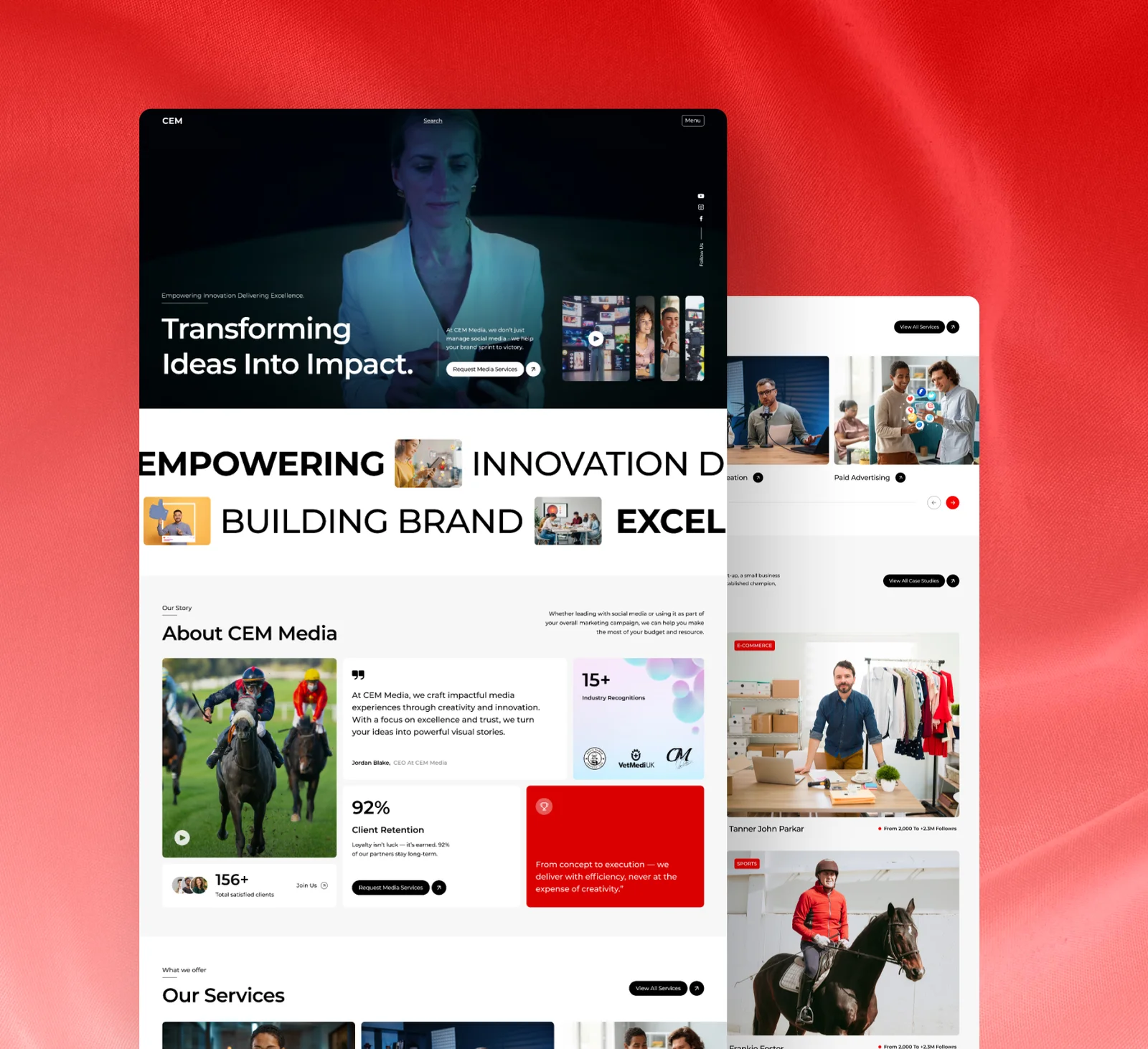
Why a £500 and a £20,000 website can look identical in a screenshot
This is the single most useful thing to understand before commissioning work. A screenshot shows one viewport, one state, one moment, with no content pressure and no measurement attached. Almost everything that separates the two sites is invisible in that frame.
| Invisible in a screenshot | What it changes in reality |
|---|---|
| Research and positioning | Whether the first sentence speaks to the buyer's actual problem |
| Conversion architecture | Whether visitors know what to do next on every page |
| Responsive behaviour | Whether the layout survives real content on a 375px screen |
| Semantic HTML | Screen reader usability and how search engines interpret structure |
| Accessibility | Whether keyboard users and assistive tech can complete the enquiry |
| Page speed | How many mobile visitors see the page at all |
| CMS architecture | Whether your team can add a service page without a developer |
| Technical SEO | Whether pages get crawled, indexed and understood |
| Integrations and security | Whether enquiries arrive, and what happens when they don't |
| Testing | Whether it works in Safari, on older Android, and after content edits |
| Analytics | Whether you can prove which pages generate revenue |
| Scalability | What it costs to add the next twenty pages |
07
What makes a good business website: a working framework
When I review an existing site for a client, I score it across these eleven areas before recommending anything. It is a deliberately boring framework, and it finds the same problems repeatedly.
- 01PositioningCan a stranger tell what you do, who for, and why you, within one screen?
- 02MessagingIs the copy about the customer's outcome or the company's history?
- 03UXIs the path from landing to enquiry short, obvious and free of dead ends?
- 04Visual designDoes the interface look current, consistent and appropriate to your price point?
- 05Mobile experienceDoes it work under a thumb, on a real device, with real content?
- 06Conversion architectureIs there a primary action on every page, with a credible reason to take it?
- 07SEODo the pages exist that match the searches you want, with an architecture that supports them?
- 08Technical qualitySemantic markup, clean URLs, no crawl traps, no broken redirects, secure forms.
- 09AccessibilityContrast, focus states, labels, keyboard operability, motion preferences.
- 10PerformanceFast first paint, controlled JavaScript, right-sized images, stable layout.
- 11TrustReal work, real names, real addresses, real proof, easy contact.
08
Website design and SEO should not be separate projects
Short answer
Most SEO outcomes are decided during design and build, not afterwards. Site architecture, URLs, heading hierarchy, internal links, navigation, template markup, image handling and performance are design decisions with search consequences.
The expensive pattern is familiar: a site is designed around a visual concept, launched, and then an SEO consultant is asked to improve visibility. They immediately need new pages the templates cannot render, a URL structure the CMS cannot produce, and headings the design treats as decoration. Half the SEO budget then pays to partially undo the build.
- Architecture: which services deserve a page, and how they relate to each other and to location relevance.
- URLs: short, stable, readable, planned before content is written.
- Content hierarchy: one H1 per page, meaningful H2s, sections that answer a real question.
- Internal linking: hubs linking to detail pages and back, rather than links stuffed in a footer.
- Templates: metadata, canonical tags, structured data and Open Graph handled by the system, not by hand.
- Images: descriptive filenames, alt attributes, modern formats, explicit dimensions.
- Performance: budgets agreed before the design invites a full-screen background video.
09
Core Web Vitals, explained for business owners
Google's Core Web Vitals measure how a page feels to a real visitor. You do not need to obsess over a score, but you should understand what the three metrics represent because each maps to a specific build decision.
| Metric | In plain English | Usual culprit |
|---|---|---|
| LCP — Largest Contentful Paint | How long until the main thing on screen appears | Huge hero images or video, slow hosting, render-blocking fonts |
| INP — Interaction to Next Paint | How quickly the page responds when tapped | Heavy JavaScript, third-party scripts, bloated page builders |
| CLS — Cumulative Layout Shift | How much the page jumps around while loading | Images without dimensions, late-loading banners, web fonts swapping |
Two practical warnings. First, a perfect score achieved by stripping out useful content is a bad trade — the metrics exist to protect user experience, not to be farmed. Second, most damage is done by things added after launch: tag managers, chat widgets, tracking pixels, pop-up tools and cookie banners. Agree who reviews additions, or your fast site will quietly become a slow one.

10
Mobile-first design is not a shrunken desktop site
For most Glasgow service businesses the majority of first visits happen on a phone, often on a mobile connection, often one-handed, often mid-task. Designing mobile-first means deciding what matters when you only have a thumb and a small rectangle.
- Tap targets large enough to hit reliably, with enough separation to avoid mistaken taps.
- Navigation that reveals your services rather than hiding everything behind one ambiguous icon.
- Forms with the right input types, sensible autofill, few required fields and visible error messages.
- A primary call to action that remains reachable without hunting.
- Images art-directed for portrait crops instead of centre-cropped desktop photography.
- Content priority: the mobile order should reflect what a hurried visitor needs first.
- A performance budget enforced on the mobile experience, not the desktop one.

11
Conversion-focused website design
Short answer
Conversion design is about removing doubt and friction at the exact moment a visitor is deciding. That means one obvious next step per page, proof near the ask, forms that are short enough to finish on a phone, and honest information about how you work.
- A clear hierarchy of actions: one primary CTA, one secondary, and nothing competing with them.
- Contact forms that ask only for what you need to reply usefully — every extra field costs completions.
- Alternative contact routes: phone, email and WhatsApp, because some buyers will never fill a form.
- Proof positioned beside the ask: relevant case studies, named testimonials, recognisable clients.
- Risk reduction: what happens after you enquire, how long a reply takes, what it will not cost you.
- Pricing guidance, even ranges — silence filters out serious buyers as often as it filters out tyre-kickers.
- Trust signals that are true and verifiable: real address, real contact details, real project work.
You can see the pattern applied on my own contact page and across the case studies: the proof sits next to the request, not three clicks away from it.
12
How local SEO and web design fit together
Google's local results are shaped by relevance, distance and prominence. Your website influences two of the three directly, and supports the third.
| Signal | What Google is assessing | What the website contributes |
|---|---|---|
| Relevance | How well your business matches the search | Clear service pages, consistent naming, useful local content |
| Distance | Proximity between searcher and business | Accurate, consistent business address and location context |
| Prominence | How well known and well regarded you are | Coverage, links, reviews, real published work |
- Keep business name, address and phone number consistent across the site, your Google Business Profile and any directories.
- Give each genuine service its own page rather than a single 'Services' list.
- Publish real project work with local context — it supports prominence far better than repeating a city name.
- Make reviews easy to leave and visible on site, without fabricating any.
- Link the profile and site to each other and keep both current.
No supplier can promise a position in the local pack, and anyone who does is describing something they do not control. There is a fuller treatment of this in the SEO Glasgow guide.
13
Should Glasgow businesses build location pages?
Short answer
Only where you genuinely serve the area and have something specific to say about it. A good location page carries real service detail, real projects and real local context. A page created by find-and- replacing "Glasgow" with "Edinburgh" is scaled content, and it tends to underperform or be ignored.
| Good location page | Doorway page |
|---|---|
| Specific services actually delivered in that area | Identical service list on every city page |
| Real projects or clients from the area | Stock imagery and no evidence |
| Local context: sectors, travel, how you work there | A city name swapped into template copy |
| Questions people in that area really ask | Generic FAQs repeated verbatim |
| A handful of pages you can maintain | Fifty cities published in one afternoon |
A reasonable Scottish footprint might be Glasgow as the primary page, Edinburgh as a genuinely distinct second, and a Scotland-wide page describing remote delivery. If you cannot write 500 honest, non-duplicated words about a location, do not publish a page for it.
14
Website builders vs bespoke development
There is no morally superior platform. There are appropriate and inappropriate choices for a given business, budget and team.
| Platform | Works well for | Watch out for |
|---|---|---|
| Squarespace / Wix | Small sites, tight budgets, non-technical owners | Design ceiling, limited technical control, harder to migrate |
| WordPress | Content-heavy sites, blogs, familiar editorial teams | Plugin sprawl, performance debt, ongoing maintenance and security |
| Shopify | Product ecommerce with standard fulfilment | Bespoke checkout logic, app subscription creep |
| Webflow | Design-led marketing sites with a small team | Costs at scale, developer-style thinking still required |
| Modern JS frameworks | Fast, bespoke, SEO-solid marketing sites and product front-ends | Requires real engineering discipline; needs SSR done properly |
| Fully custom | Portals, dashboards, product-specific workflows | Higher cost and a genuine need for ongoing ownership |
Whichever route you choose, insist on the same three things: you own the domain, you own the content, and you can move if the relationship ends.
15
AI website builders in 2026: an honest assessment
AI has genuinely changed the production side of web work. It accelerates wireframing, first-draft content structure, prototyping, boilerplate development, test writing and refactoring. Used well, it removes hours of mechanical effort from a project.
What it does not yet remove is judgement. Positioning against local competitors, deciding what to leave out, designing a form journey around how your sales team actually works, meeting accessibility requirements, choosing an architecture that will survive three years of content, keeping data secure, and making a brand look distinct rather than generically competent — these remain decisions someone has to own.
- AI-generated sites often share a visual and structural sameness that undermines differentiation.
- Generated copy tends to describe the category rather than your specific advantage.
- Accessibility and semantic structure are frequently approximate.
- Technical SEO defaults are usually adequate, rarely strategic.
- The output still needs someone accountable for whether it converts.
The practical position: use AI to go faster, not to skip the thinking. That is how I use it in my own work, including on custom software projects.
16
20 questions to ask a web designer before hiring them
Ask these in writing. The answers, and the willingness to give them, tell you more than any portfolio.
Hiring questions
- Who owns the domain, and in whose account is it registered?
- Who owns the website content and imagery after launch?
- Who owns the source code, and do I get a copy?
- Will I receive full admin access to the CMS and hosting?
- Who exactly does the design work, and who writes the code?
- Is technical SEO included, and what specifically does that cover?
- Who writes the content, and is copywriting in the quote?
- How is the site tested on real mobile devices and browsers?
- What accessibility standard do you work to?
- What happens to my existing rankings during migration?
- How are redirects mapped and verified?
- Is analytics configured, and are conversions tracked as events?
- Will Search Console be set up and shared with me?
- Where is the site hosted, and in whose account?
- What is the plan for backups and recovery?
- How are updates, security and dependencies handled after launch?
- What is the support arrangement, and what does it cost?
- Can my team add pages without a developer?
- What happens if we stop working together?
- Can I speak to a client whose site launched at least a year ago?
17
Website redesign checklist
Redesigns lose more traffic than new builds, and almost always for avoidable reasons. Work through this before, during and after launch.
Before
- Full backup of the current site, database and media
- Benchmark analytics: sessions, conversions, top landing pages
- Export Search Console queries and page performance
- Crawl every existing URL, including PDFs and images
- Record current titles, descriptions and structured data
- List every form, integration and tracking script in use
- Identify the pages that generate enquiries — protect them
- Agree a performance and accessibility target
During
- Map old URLs to new ones, one by one, with 301 redirects
- Preserve or deliberately improve metadata for retained pages
- Migrate content properly rather than pasting from Word
- Rebuild structured data on the new templates
- Test every form end to end, including notification emails
- Recreate analytics events and conversion definitions
- Check DNS and email records before any host change
After
- Verify indexability: no stray noindex, correct robots.txt
- Submit the new XML sitemap in Search Console
- Crawl the live site for broken links and redirect chains
- Test on real phones, not just a browser resize
- Watch Search Console coverage and queries for four weeks
- Compare conversions, not just traffic, against the benchmark
18
Common web design mistakes Glasgow businesses should avoid
- Judging the project on appearance alone and never testing whether it converts.
- A heavy autoplaying hero video that delays the one thing a visitor came to read.
- Headlines that describe the company rather than the customer's problem.
- No obvious next step on interior pages.
- No proof: no case studies, no named testimonials, no evidence of real work.
- Mobile forms with a dozen required fields and no error handling.
- Template copy that could belong to any competitor in Scotland.
- Animation used everywhere, so nothing is emphasised and everything is slower.
- No analytics, or analytics with no conversion tracking configured.
- Technical SEO treated as a post-launch upsell.
- No written clarity on who owns the domain, code and content.
19
How I approach a website project
For transparency, this is the process behind the work in my case studies. It is deliberately linear at the start and iterative after launch.
- 01DiscoveryCommercial goals, buyers, sales process, current performance and constraints.
- 02ResearchCompetitor review, search demand, content gaps, technical audit of the existing site.
- 03ArchitecturePage structure, URLs, navigation and the internal linking plan.
- 04ContentMessage hierarchy per page, drafted before design where possible.
- 05UXWireframes for the key journeys, mobile first, with forms designed rather than assumed.
- 06UIA design system — type, colour, components — not a set of one-off page images.
- 07DevelopmentSemantic, accessible, fast, with a CMS your team can actually use.
- 08SEOMetadata, structured data, redirects, sitemap, Search Console.
- 09QAReal devices, browsers, forms, integrations, accessibility checks.
- 10LaunchRedirect verification, tracking validation, monitoring for the first weeks.
- 11IterationMeasure, improve pages that underperform, add content that earns visibility.
20
Choosing a website designer in Glasgow: final framework
- 01Define the commercial job firstEnquiries, bookings, credibility or recruitment — pick the primary one.
- 02Judge evidence, not decksOpen live sites on your phone. Check speed, structure and whether they still work.
- 03Check the disciplinesConfirm who covers UX, development, content, SEO and analytics.
- 04Compare deliverables, not headline pricesTwo quotes are only comparable when the scope lists match.
- 05Settle ownership in writingDomain, hosting, code, content and access — before work starts.
- 06Agree how success is measuredDefine the conversion events and the review cadence up front.
- 07Plan for after launchSupport, iteration and who is responsible for performance over time.
21
Frequently asked questions
How long does a website project take in Glasgow?
A focused business site is typically a matter of weeks; a larger bespoke build with content, integrations and migration usually runs across several months. Content readiness is the most common cause of delay, so agreeing who writes what — and when — is the single biggest schedule lever.
Is a freelance web designer cheaper than an agency?
Often, because the overhead is lower, but that is not the main reason businesses choose one. The usual reason is direct access to the person doing the work. Compare scope and seniority rather than day rates.
Do you work with businesses in Edinburgh and elsewhere in Scotland?
Yes. I'm based in Glasgow and work with businesses in Edinburgh, across Scotland and throughout the UK. Discovery and reviews happen in person where useful and remotely where that's more practical.
Will a new website improve my Google rankings?
A better-structured, faster, more useful site removes obstacles and gives search engines better material to work with, and a well-handled migration protects what you already have. Nobody can promise specific positions — competition and authority also decide outcomes.
Can you redesign my site without losing existing traffic?
That is the goal of a proper migration: crawl the existing URLs, map redirects, preserve or improve metadata, keep the pages that earn enquiries, and monitor Search Console after launch. Risk comes from redesigns that skip those steps.
Who owns the website when the project is finished?
You should. Domain in your account, hosting in your name or transferable, source code and content yours, full admin access handed over. Get that in writing with any supplier.
Looking for a website designer in Glasgow?
If you're planning a new website, a redesign or a more complex digital platform, Shahroz combines UX/UI, development and SEO within one direct process.
Working with businesses across Glasgow, Edinburgh, Scotland and the wider UK.
Continue reading
- SEOSEO Glasgow: Complete 2026 Guide →Technical SEO, local search, AI Overviews, costs and how to judge an SEO consultant.
- Digital MarketingDigital Marketing Scotland 2026 →How design, search, paid media and CRO combine into one acquisition system.
- DevelopmentWebsite Development Glasgow: 2026 Guide →Platforms, build quality, hosting, accessibility and handover explained.
- ServiceWebsite development in Glasgow →How I scope, build and support websites for Scottish businesses.